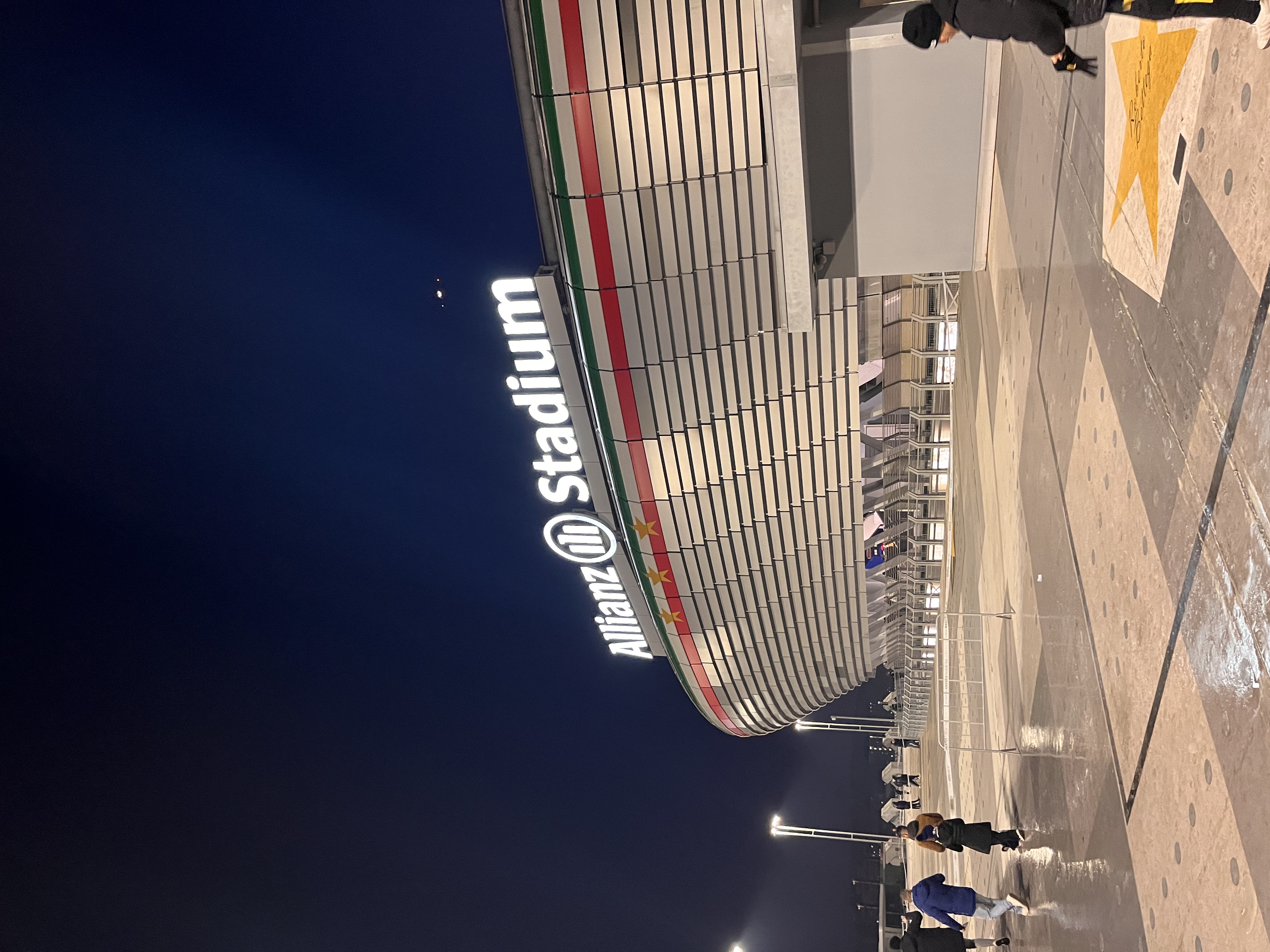
Turin does not try very hard to sell itself. It is not Rome with its monuments, not Florence with its galleries, not Venice with its canals. It is a city of wide boulevards and baroque arcades, of factory history and engineering pride, of a football club so dominant for so long that its relationship with the rest of Italian football is essentially a long-running argument about fairness. Foreign visitors who end up here tend to be surprised. They usually want to come back.
A Juventus matchday is the best version of Turin you can have in a weekend. Not because the Allianz Stadium is particularly beautiful — it isn’t, or not in any conventional sense — but because the city comes into focus on a matchday in a way it doesn’t otherwise. The aperitivo culture, the Torinese reserve that turns into volume inside a stadium, the particular pride of a fanbase that has been watching their club win things for a century and still treats each match like it matters specifically. All of that is available. Most foreign fans miss it by arriving too late and leaving too early.
Turin: The City Foreign Fans Underestimate
Italy’s fourth-largest city spent the second half of the twentieth century being defined by Fiat. The car industry shaped everything — the population, the immigration patterns, the politics, the stadium itself, which sits in a part of the city that used to be dominated by factory workers. Post-industrial Turin has reinvented itself quietly and well. The Egyptian Museum is the second most important in the world after Cairo. The Mole Antonelliana is one of the most distinctive buildings in Europe. The aperitivo scene — Turin invented the aperitivo, and the vermouth that anchors it — is serious, affordable, and almost completely untouched by the tourist economy that has saturated the same culture in Milan.
Juventus supporters know all of this, in the way that people always know their city better than visitors do. They also know that their club is the most followed in Italy, the most decorated in the domestic game, and the most resented — which is its own kind of status. The Bianconeri identity is not a casual thing. It is inherited, argued about, worn with a particular combination of pride and defensiveness that only makes sense once you’ve sat with it for a while.
Before the Match: Where to Be in Turin
The temptation for foreign fans is to base themselves in the centre — near the station, around Piazza San Carlo — and treat the stadium trip as a commute. This is understandable and slightly wrong. The pre-match hours in Turin reward movement.
The Quadrilatero Romano is where to start. The neighbourhood sits just north of Piazza Castello, a tightly packed grid of narrow streets that was the Roman city and is now the city’s best neighbourhood for food and drink. On a matchday afternoon it operates at a particular frequency: not quite pre-match-bar loud, not quite weekend-lunch quiet. The bars here do aperitivo properly, which means a drink and a spread of food for a price that still feels like 2005. Order a Vermouth di Torino. Do not order anything else for at least the first round.
Piazza Vittorio Veneto, a few minutes east, is Turin’s largest square — a vast, slightly underused piazza that runs down to the Po river. On matchdays the bars around its arcades fill with a mix of locals and travelling supporters. The view from the riverbank toward the hills — the Superga basilica visible on the ridge, the site of the 1949 Grande Torino disaster — is one of the better ones in northern Italy, and most people who see it for the first time were not expecting it.
What to eat before a Juventus match:
- Vitello tonnato — cold sliced veal with a tuna and caper sauce; distinctly Torinese, divisive at first glance, revelatory in practice. Order it wherever you see it
- Agnolotti del plin — small, pinched fresh pasta, typically filled with roast meat. A Sunday dish in Piedmont, available on matchday in almost any trattoria that takes its region seriously
- Bicerin — Turin’s historic hot drink: espresso, drinking chocolate, and cream in layers, not stirred. The Cafè Al Bicerin near the Palazzo Reale has been serving it since 1763. Worth the detour
- Vermouth di Torino — the city invented it. Martini and Cinzano were both born here. Drinking it in Turin, before a Juventus match, is the kind of thing that sounds like a cliché and turns out to be completely accurate
The Allianz Stadium: What You Need to Know
The Allianz Stadium opened in 2011 and was the first Italian club-owned stadium built from scratch since the 1930s. That fact alone tells you something about Italian football’s complicated relationship with infrastructure. It holds just over 41,000 people, has no running track separating the crowd from the pitch, and produces an atmosphere that is noticeably better than almost anything else Serie A offers — precisely because the stands are close, the sightlines are good, and the crowd is not being held at a distance from the game.
The Curva Sud is the ultras end, home to the organised supporter groups that have been the engine of Juventus fan culture for decades. If you have a Curva Sud ticket and you are comfortable in that kind of atmosphere, go. The choreography, the flags, the noise level from the first whistle — this is what an Italian Curva is supposed to feel like. If you are attending as a neutral observer, the Tribuna sections give you a cleaner view and a more manageable environment.
Getting there: The stadium sits in the Continassa area, in the northwest of the city. Metro Line 1 runs to the Fermi stop, followed by a shuttle bus to the ground — the total journey from the city centre takes around thirty minutes. Tram line 9 connects from Piazza Vittorio. Neither option is complicated; both get overcrowded in the hour before kickoff. Leave more time than you think you need.
What to bring: ID or passport, your ticket (usually mobile via the club app or Vivaticket), and cash. Tickets for high-profile fixtures — Milan, Inter, Roma — sell fast. The club’s official site redirects to Juventus Ticket, their authorised platform. Buy early, check the category carefully, and be aware that the away section is strictly segregated.
What Foreign Fans Almost Always Miss
The Allianz Stadium is loud before it is full. The Curva Sud begins proper noise — drums, choreography, call-and-response — well before kickoff, while the rest of the ground is still filling. Foreign fans who arrive at the stadium ten minutes before the whistle arrive after the opening act is already underway.
There is also a particular quality to the pre-match silence that falls in the Allianz in the moments before kickoff — forty thousand people simultaneously holding something back — that turns into the specific Juventus roar as the referee blows. It is not the loudest stadium in Italy. It might be the most focused. The crowd here is not there to have a day out. It is there to watch Juventus win, and it has been doing this long enough to know exactly what it wants.
Turin invented the aperitivo. It also produced the most decorated club in Italian football. These are not unrelated things — both require patience, refinement, and the belief that doing something properly is worth the time it takes.
A Note on the Turin Derby
If you are attending a Juventus vs Torino derby — the Derby della Mole — the above applies with additional considerations. Torino FC carries the weight of the Grande Torino legacy, the 1949 air disaster that killed one of the greatest club sides in Italian history. The derby is not as geographically divided as Rome’s, but it carries its own deep current of class and neighbourhood identity. Granata and Bianconeri supporters have been navigating the same city for over a century. The matchday atmosphere on derby day is a different frequency from a standard league fixture — recognisably the same city, operating at a different voltage.
A Note on Safety and Common Sense
The Allianz Stadium is well-stewarded and one of the more professionally managed grounds in Serie A. The ultras culture in the Curva Sud is organised and present but does not typically create problems for foreign visitors who navigate the ground sensibly. The usual rules apply: know which end your ticket is for, don’t wear opposition colours in the wrong section, and move with the crowd rather than against it on the way out. The city itself is calm. Turin has none of the tourist-volume pressure that makes Rome or Florence feel hectic. It is a city that is comfortable with itself, and it extends that comfort to visitors who approach it on its own terms.
Do It Properly
The Quadrilatero Romano at aperitivo hour. The Vermouth di Torino. The shuttle to the Allianz. The Curva Sud in full voice before the whistle. These things are all available to any foreign fan who arrives in Turin on a matchday. The difference between finding them and missing them is usually a few hours and someone who knows where to go.
FanHoppers runs matchday experiences for foreign fans at Juventus home fixtures in Turin. Small groups, a local Ambassador who knows this city from the inside, and the version of the day most people never find first time around.
Get Launch Updates